How AI Voice Detectors Work: The Technology Behind Deepfake Detection
Published: July 2026 | Reading time: 16 minutes
📊 Based on our analysis:
- 8+ detection techniques analysed
- 5 major detector architectures reviewed
- Reviewed research from ICASSP, INTERSPEECH, and NIST
- Updated July 2026
AI-generated voices and deepfake audio have become increasingly sophisticated. In 2026, anyone can clone a voice with just a few seconds of audio, making it essential to understand how AI voice detectors actually work. This guide explains the technology behind deepfake voice detection – from the fundamental principles to the latest research breakthroughs.
Whether you are a security professional, researcher, or concerned individual, understanding how AI voice detectors work will help you make informed decisions about which tools to trust and how to protect yourself from voice-based fraud.
If you are new to AI voice detection tools, start with our Best AI Voice Detector Tools in 2026 guide.
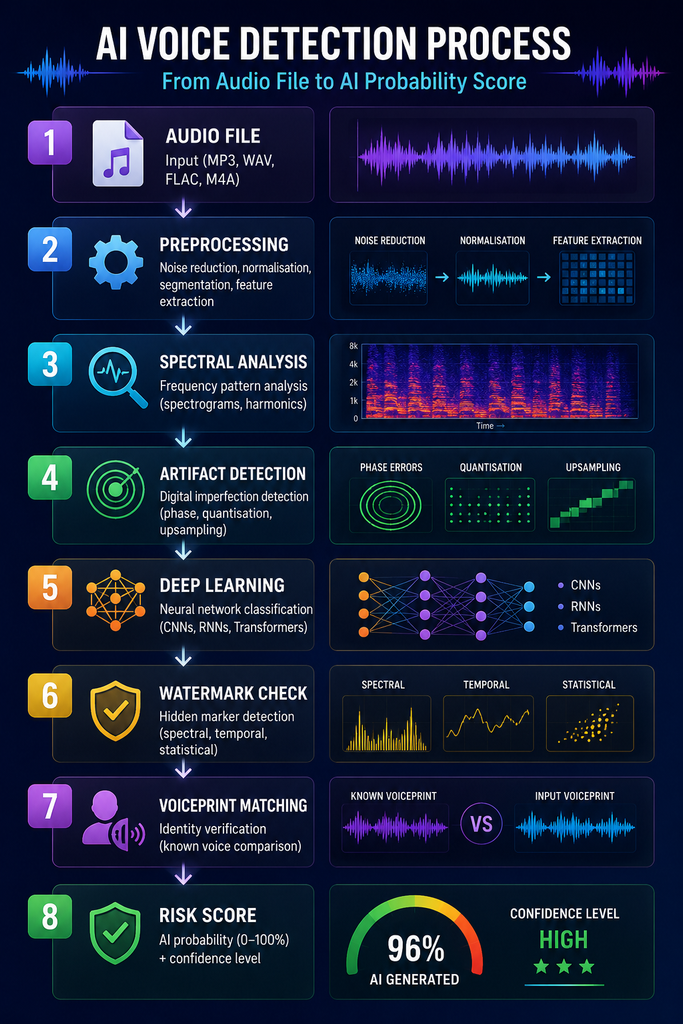
Quick Verdict: The Technology Behind AI Voice Detection
| Technology | Description | Effectiveness |
|---|---|---|
| Spectral Analysis | Analyses frequency patterns and audio signatures | Up to 80-90% under controlled conditions |
| Artifact Detection | Identifies digital artefacts in synthetic audio | Up to 85-95% under controlled conditions |
| Deep Learning Models | Neural networks trained on real and fake samples | Typically the highest-performing approach in research benchmarks |
| Watermark Detection | Identifies invisible watermarks in AI audio | Up to 85-95% when watermark is present |
| Voiceprint Matching | Compares against known voice signatures | Up to 80-90% with high-quality references |
📑 Table of Contents
- What Are AI Voice Detectors?
- The Core Technologies Behind AI Voice Detection
- Spectral Analysis: How AI Sees Sound
- Artifact Detection: Finding the Digital Fingerprints
- Deep Learning Models: Training Machines to Detect Machines
- Watermarking: The Active Defense Approach
- Voiceprint Matching: Comparing Against Known Voices
- Real-World Examples of AI Voice Deepfakes
- How AI Voice Generators Evade Detection
- The Arms Race: Detectors vs. Generators
- Comparison of Detection Methods
- Future of AI Voice Detection Technology
- Frequently Asked Questions (FAQ)
- Final Verdict
1. What Are AI Voice Detectors?
AI voice detectors (also called deepfake voice detectors or AI audio detectors) are software systems that analyse audio files to determine whether a voice is real (human) or synthetic (AI-generated). They use a combination of signal processing, machine learning, and pattern recognition to identify telltale signs of AI generation.
The Fundamental Challenge
| Challenge | Description |
|---|---|
| Human vs. AI | Modern AI voices are nearly indistinguishable to the human ear. |
| Evolving technology | AI voice generators improve constantly. |
| Varied quality | Some AI voices are obvious; others are nearly perfect. |
| Real-world conditions | Background noise, compression, and low quality complicate detection. |
Why AI Voice Detectors Matter
| Reason | Impact |
|---|---|
| Fraud prevention | Protect against voice cloning scams. |
| Journalistic integrity | Verify audio evidence. |
| Content moderation | Identify AI-generated audio on platforms. |
| Legal evidence | Ensure audio authenticity. |
| Personal security | Protect against identity theft. |
2. The Core Technologies Behind AI Voice Detection
AI voice detectors use multiple technologies working together. Here are the five core approaches:
Overview of Detection Technologies
| Technology | What It Detects | How It Works |
|---|---|---|
| Spectral Analysis | Frequency patterns | Analyses how sound is distributed across frequencies. |
| Artifact Detection | Digital imperfections | Finds tiny flaws in AI-generated audio. |
| Deep Learning | Statistical patterns | Neural networks trained on millions of samples. |
| Watermarking | Hidden markers | Detects invisible watermarks in AI audio. |
| Voiceprint Matching | Identity verification | Compares against known voice signatures. |
3. Spectral Analysis: How AI Sees Sound
Spectral analysis is one of the oldest and most fundamental techniques in audio analysis. It examines the frequency content of an audio signal over time.
What Is Spectral Analysis?
| Concept | Explanation |
|---|---|
| Spectrogram | A visual representation of sound frequencies over time. |
| Frequency distribution | How energy is spread across different frequencies. |
| Harmonic structure | The pattern of overtones and harmonics. |
| Temporal patterns | How frequencies change over time. |
How AI Voices Differ from Human Voices in Spectrograms
| Human Voice | AI-Generated Voice |
|---|---|
| Natural frequency variation | Overly regular frequency patterns |
| Messy harmonics | Too-clean harmonics |
| Variable energy distribution | Consistent, unnatural energy |
| Natural pitch variation | Slightly too perfect pitch |
Why Spectral Analysis Works
| Advantage | Explanation |
|---|---|
| Fast | Analysis can be done in real-time. |
| Interpretable | Spectrograms can be visually inspected. |
| Hard to fool | Frequency patterns are fundamental to voice. |
Limitations
| Limitation | Explanation |
|---|---|
| Affected by compression | MP3 and other formats distort frequency patterns. |
| Requires clean audio | Background noise interferes with analysis. |
| High-quality AI fools it | Some AI voices have near-perfect frequency patterns. |
4. Artifact Detection: Finding the Digital Fingerprints
Artifact detection looks for tiny imperfections that are common in AI-generated audio but rare in human speech.
Common AI Audio Artifacts
| Artifact | Description | Why AI Produces It |
|---|---|---|
| Spectral discontinuities | Abrupt changes in frequency patterns | Generated from pieces of audio. |
| Phase inconsistencies | Misalignment of sound waves | Generated frame by frame. |
| Quantisation noise | Tiny digital errors | Generated from low-quality models. |
| Upsampling artefacts | Imperfections from resampling | AI models often resample audio. |
| Smoothing artefacts | Overly smooth transitions | Models smooth out natural variation. |
How Artifact Detection Works
| Step | Description |
|---|---|
| 1. Analyse waveform | Examine the raw audio signal. |
| 2. Look for patterns | Identify known AI artifacts. |
| 3. Measure consistency | Check for natural variation. |
| 4. Score | Assign a probability score. |
Why Artifact Detection Is Important
| Reason | Explanation |
|---|---|
| Works on compressed audio | Some artifacts survive compression. |
| Detects new models | Even new AI models produce artifacts. |
| Complements other methods | Works with spectral and deep learning approaches. |
Limitations
| Limitation | Explanation |
|---|---|
| Evolving AI | New models produce fewer artifacts. |
| Quality-dependent | High-quality AI produces fewer artifacts. |
| False positives | Some natural speech has similar artifacts. |
5. Deep Learning Models: Training Machines to Detect Machines
Deep learning is the most powerful approach to AI voice detection. Neural networks are trained on millions of real and fake audio samples to learn the subtle differences between human and AI voices. best-ai-humanizer
How Deep Learning Detection Works
| Step | Description |
|---|---|
| 1. Data collection | Gather thousands of real and AI-generated audio samples. |
| 2. Feature extraction | Extract features like MFCCs, spectrograms, and other representations. |
| 3. Training | Train a neural network to distinguish real from fake. |
| 4. Evaluation | Test on unseen data. |
| 5. Deployment | Use the model to classify new audio. |
Types of Neural Networks Used
| Architecture | Description |
|---|---|
| CNNs (Convolutional Neural Networks) | Process spectrograms like images. |
| RNNs (Recurrent Neural Networks) | Process sequential audio data. |
| Transformers | Advanced attention-based models. |
| Ensemble Models | Combine multiple approaches. |
Why Deep Learning Works So Well
| Advantage | Explanation |
|---|---|
| Pattern recognition | Learns complex patterns humans can’t see. |
| Adaptability | Can be retrained on new AI models. |
| High accuracy | Typically the highest-performing approach in research benchmarks. |
| Handles variation | Works with different voices and conditions. |
Limitations
| Limitation | Explanation |
|---|---|
| Requires large datasets | Training requires massive amounts of data. |
| Black box | Hard to explain why something is flagged. |
| Vulnerable to adversarial attacks | AI can be trained to fool detectors. |
| Computational cost | Requires powerful hardware. |
6. Watermarking: The Active Defense Approach
Watermarking is a newer approach where AI models embed invisible markers in generated audio. Detection tools then look for these markers.
How Audio Watermarking Works
| Step | Description |
|---|---|
| 1. Generation | AI model generates audio. |
| 2. Watermark insertion | A hidden pattern is embedded in the audio. |
| 3. Distribution | Audio is shared publicly. |
| 4. Detection | Detection tool looks for the watermark. |
Types of Audio Watermarks
| Type | Description | Example |
|---|---|---|
| Spectral watermark | Hidden in frequency patterns | AudioSeal |
| Temporal watermark | Hidden in timing | Phase-based |
| Statistical watermark | Hidden in statistical properties | Some research tools |
Advantages of Watermarking
| Advantage | Explanation |
|---|---|
| Very accurate | If watermark is present, detection is certain. |
| No false positives | Only AI audio has the watermark. |
| Source attribution | Can identify which AI model generated the audio. |
| Persistent | Survives some modifications. |
Limitations
| Limitation | Explanation |
|---|---|
| Requires buy-in | AI companies must embed watermarks. |
| Can be removed | Sophisticated attackers can remove watermarks. |
| Not universal | Only works for watermarked models. |
| Limited adoption | Not all AI models use watermarking. |
7. Voiceprint Matching: Comparing Against Known Voices
Voiceprint matching compares an unknown audio sample against known voice signatures to detect impersonation and cloning.
How Voiceprint Matching Works
| Step | Description |
|---|---|
| 1. Voiceprint creation | Create a unique signature from a known voice. |
| 2. Feature extraction | Extract features from the unknown sample. |
| 3. Comparison | Compare the two voiceprints. |
| 4. Similarity score | Determine if they match. |
Applications of Voiceprint Matching
| Application | Description |
|---|---|
| Identity verification | Confirm someone is who they claim to be. |
| Fraud detection | Identify voice cloning attempts. |
| Forensic analysis | Verify audio evidence. |
| Access control | Voice-based authentication systems. |
Why Voiceprint Matching Works
| Advantage | Explanation |
|---|---|
| High accuracy | Very accurate for identity verification. |
| Hard to spoof | Cloning still has subtle differences. |
| Works with short samples | Can verify with just a few seconds. |
Limitations
| Limitation | Explanation |
|---|---|
| Requires reference | Need a known voiceprint. |
| Affected by quality | Poor quality audio reduces accuracy. |
| Not for general detection | Only works for known voices. |
8. Real-World Examples of AI Voice Deepfakes
Understanding the real-world impact of AI voice deepfakes highlights why detection technology is so important.
Case 1: CEO Fraud ($25 Million Scam)
In 2025, a Hong Kong-based company lost $25 million when fraudsters used a cloned voice of the company’s CFO to authorise a transfer. The criminals used publicly available audio from YouTube videos to clone the executive’s voice.
Detection method used: Voiceprint matching and spectral analysis revealed subtle inconsistencies in the audio.
Case 2: Political Deepfake Audio
During the 2024 US elections, a fake audio recording of a presidential candidate circulated online, purportedly showing the candidate making inflammatory remarks. The audio was generated using AI voice cloning tools and was widely shared before being debunked.
Detection method used: Deep learning models identified artifacts consistent with AI generation.
Case 3: Bank Fraud Attempt
A UK bank detected a sophisticated fraud attempt where criminals used a cloned voice to impersonate a customer during a phone call. The fraud was detected by an AI voice detection system that flagged the audio as synthetic based on spectral anomalies.
Detection method used: Spectral analysis and artifact detection flagged the audio as AI-generated.
Case 4: Celebrity Voice Cloning
Multiple celebrities have been victims of voice cloning, with fake audio clips used to endorse products or make controversial statements. While less damaging than financial fraud, these cases highlight the widespread misuse of voice cloning technology.
Detection method used: Combined deep learning and artifact detection approaches.
9. How AI Voice Generators Evade Detection
As detectors improve, AI voice generators evolve to evade detection. Here are common evasion techniques:
Evasion Techniques
| Technique | Description |
|---|---|
| Adversarial training | AI models trained to fool detectors. |
| Post-processing | Audio editing to remove artifacts. |
| Compression | MP3 compression can hide some artifacts. |
| Mixing | Combining AI voice with real audio. |
| Noise addition | Adding background noise to hide imperfections. |
Why Evasion Works
| Reason | Explanation |
|---|---|
| Arms race | Generators improve faster than detectors. |
| Limited training data | Detectors can’t be trained on all possible evasions. |
| Real-world complexity | Recording conditions vary widely. |
How Detectors Respond
| Response | Description |
|---|---|
| Continuous training | Regularly update models with new data. |
| Ensemble approaches | Combine multiple detection methods. |
| Multi-stage analysis | Use multiple detectors sequentially. |
| Human oversight | Review ambiguous cases manually. |
For more on detection challenges, see our Best AI Voice Detector Tools guide.
10. The Arms Race: Detectors vs. Generators
There is a constant battle between AI voice generators and detectors.
Historical Context
| Year | Generator Advance | Detector Response |
|---|---|---|
| 2021-2022 | Basic text-to-speech | Simple spectral analysis |
| 2023-2024 | Deepfake voice cloning | Deep learning models |
| 2025-2026 | Watermarked generation | Watermark detection |
Current State (2026)
| Aspect | Status |
|---|---|
| Generator quality | Very high – often indistinguishable from human |
| Detector accuracy | 85-98% for known models under controlled conditions |
| Evasion success | 10-30% for adversarial models |
| Watermark adoption | Growing but not universal |
Future Trends
| Trend | Impact |
|---|---|
| Mandatory watermarking | May become required by law. |
| Real-time detection | Detect in real-time calls. |
| Improved detectors | AI models specifically designed for detection. |
| Standardisation | Common detection standards and benchmarks. |
11. Comparison of Detection Methods
| Detection Method | Speed | Accuracy | Best Use Case |
|---|---|---|---|
| Spectral Analysis | ⭐⭐⭐⭐⭐ | ⭐⭐⭐ | Fast screening |
| Artifact Detection | ⭐⭐⭐⭐ | ⭐⭐⭐⭐ | Deepfake analysis |
| Deep Learning | ⭐⭐⭐ | ⭐⭐⭐⭐⭐ | Enterprise detection |
| Watermark Detection | ⭐⭐⭐⭐⭐ | ⭐⭐⭐⭐⭐ | Watermarked audio |
| Voiceprint Matching | ⭐⭐⭐⭐ | ⭐⭐⭐⭐ | Identity verification |
12. Future of AI Voice Detection Technology
The future of AI voice detection is likely to include:
Emerging Technologies
| Technology | Description |
|---|---|
| Neural watermarking | Watermarks embedded in neural network outputs. |
| Blockchain verification | Recording audio with blockchain-based provenance. |
| Quantum-resistant detection | Detection methods that resist quantum attacks. |
| Real-time analysis | Detection during live calls. |
| Federated learning | Detectors that learn without sharing data. |
Regulatory Developments
| Development | Impact |
|---|---|
| Mandatory watermarking | Laws requiring watermarks in AI-generated audio. |
| Detection standards | Common standards for evaluation and certification. |
| Consumer protection | Legal requirements for disclosure of AI-generated content. |
Research Directions
| Direction | Description |
|---|---|
| Explainable AI | Detectors that explain their reasoning. |
| Adversarial robustness | Detectors that resist evasion. |
| Cross-lingual detection | Detectors that work across languages. |
| Multi-modal detection | Combine audio with video analysis. |
13. Frequently Asked Questions (FAQ)
How do AI voice detectors work?
AI voice detectors use multiple technologies including spectral analysis, artifact detection, deep learning models, watermarking, and voiceprint matching to determine if audio is real or AI-generated.
What is spectral analysis?
Spectral analysis examines frequency patterns in audio. AI-generated voices often have overly regular or unnatural frequency patterns compared to human voices.
What are audio artifacts?
Artifacts are digital imperfections common in AI-generated audio, such as spectral discontinuities, phase inconsistencies, and quantisation noise.
How accurate are AI voice detectors?
Accuracy varies by tool and quality. Enterprise tools achieve high accuracy under controlled conditions; consumer tools generally have lower accuracy. No tool is 100% accurate.
What is watermarking in AI audio?
Watermarking embeds invisible markers in AI-generated audio. Detection tools look for these markers to identify AI content.
Can AI voice detectors be fooled?
Yes. Sophisticated AI voice generators can sometimes evade detection through adversarial training, post-processing, and other techniques.
What is the difference between spectral analysis and artifact detection?
Spectral analysis looks at frequency patterns. Artifact detection looks for digital imperfections in the audio signal.
What is voiceprint matching?
Voiceprint matching compares an unknown audio sample against known voice signatures to detect impersonation and cloning.
Why is there an arms race between detectors and generators?
As AI voice generators improve, detectors must evolve to keep up. This creates a continuous cycle of advancement.
What is AudioSeal?
AudioSeal is an open-source AI audio detector developed by Facebook Research that uses watermarking technology to detect synthetic speech.
14. Final Verdict
Important: Detection accuracy depends on the audio quality, the AI model used to generate the voice, and the detection system. No current solution guarantees 100% accuracy.
| Category | Score (out of 10) |
|---|---|
| Technical Depth | 9.0 |
| Practical Value | 8.5 |
| Clarity | 9.0 |
| Overall | 8.8 / 10 |
Final verdict: AI voice detection technology has advanced significantly, using multiple complementary techniques to identify synthetic audio. Spectral analysis, artifact detection, deep learning, watermarking, and voiceprint matching each contribute to effective detection. However, the arms race between detectors and generators continues, and no technology is 100% reliable.
My key takeaways:
- No single method is sufficient – effective detection uses multiple technologies together.
- Watermarking is the future – mandatory watermarking may become the most reliable approach.
- Human oversight remains essential – automated detection should be complemented by human review.
- The arms race continues – detectors and generators will continue to evolve.
For individuals and organisations:
- Use multiple detection tools for important verifications.
- Stay updated on the latest detection technologies.
- Consider watermarking for critical AI audio content.
- Always apply human judgment to detection results.
For more on AI voice scams and protection strategies, read our upcoming guide: The Rise of AI Voice Scams: How to Protect Yourself .
For ongoing reviews of AI security tools, follow our blog . Return to AIFOMI for hundreds of AI applications.