Google I/O 2026: Is Agentic AI Replacing Chatbots?
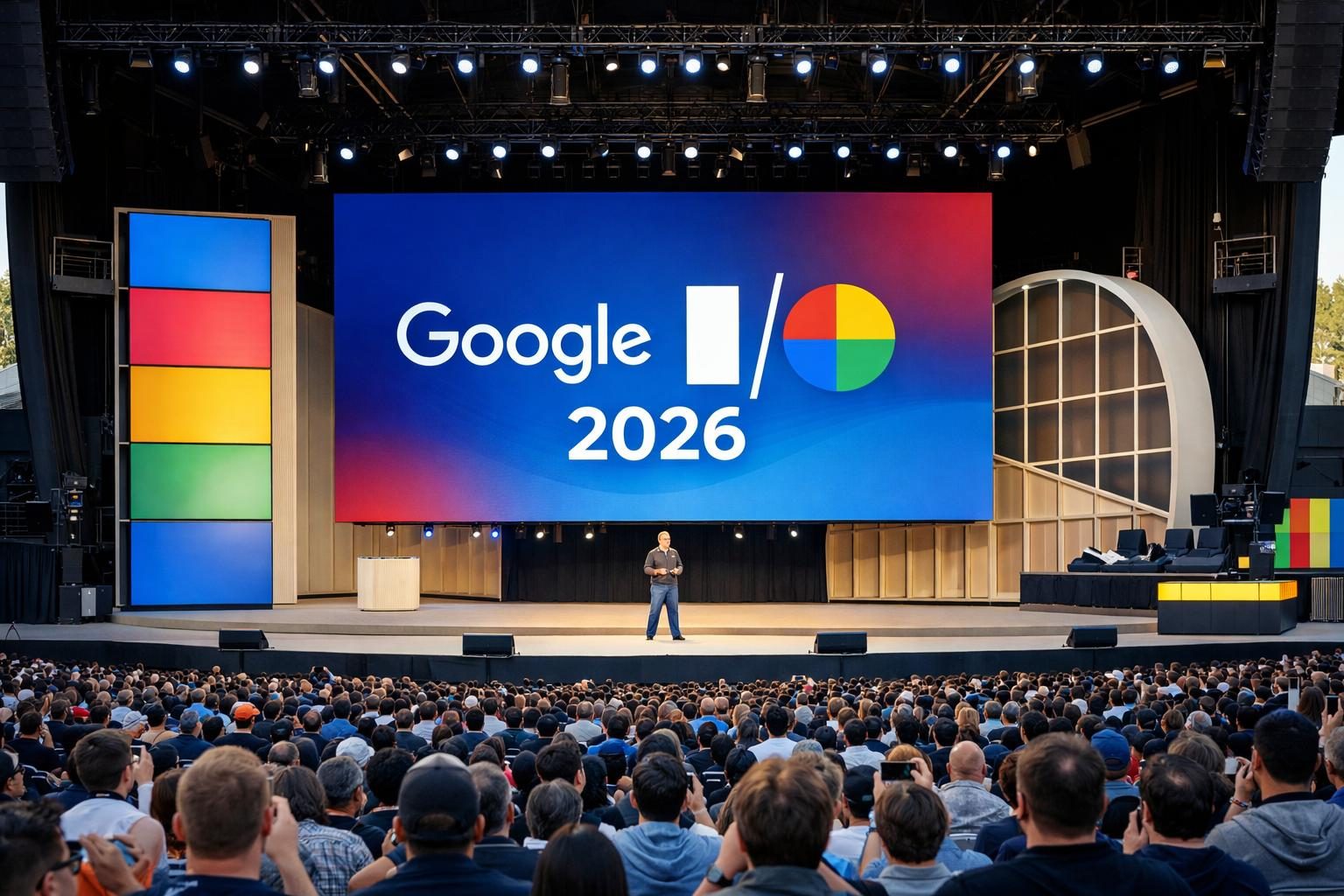
At Google I/O 2026, held on May 20, 2026, Google did not simply announce a new model or a single feature improvement. Instead, the company unveiled a complete vision for the future of AI: the transition from Chatbots to Agentic AI — systems that work continuously, execute tasks across multiple applications, and take actions on behalf of the user.
This is not just another incremental update; it is a redefinition of AI’s role in our daily lives. From search to email, from video editing to coding, Google is embedding AI everywhere — but this time as an active agent, not a passive assistant. In this article, we explore the key announcements and ask: is this the beginning of the end for chatbots as we know them? blog.google
🧠 What Is Agentic AI and Why Is It Different?
Agentic AI refers to an artificial intelligence system that can act independently — not just answer questions but perform a sequence of actions to achieve a specific goal. Imagine asking your assistant to “book a dinner with my friend,” and it checks your calendar, calls the restaurant, and makes the reservation on your behalf.
At this year’s I/O, Google leaned heavily into this shift. As noted by The Economic Times: “Google I/O 2026 made one thing clear: the future of computing will revolve around autonomous AI agents that can think, act, and assist continuously across every surface.” Tech reports also highlighted that the core theme was “accelerating the shift from prompts to action.”
In short, we are moving from “AI that helps you answer” to “AI that executes tasks for you.” This is the key to understanding every announcement made at the event. best-ai-writing-tools-in-2026
📦 Announcement 1: Gemini 3.5 Flash – The High‑Speed Brain Behind Agents
The new Gemini 3.5 Flash model was the centerpiece of the conference. Contrary to expectations that focused solely on performance, Google designed this model to be “4 times faster” than GPT‑5.5 and Claude Opus 4.7, while delivering top‑tier intelligence. It became the default model in the Gemini app and in Google Search starting May 19, 2026. blog.google
🚀 A Leap in Performance and Speed
Speed isn’t the only advantage. 3.5 Flash outperformed its predecessor Gemini 3.1 Pro across nearly all benchmarks, especially in coding and agentic tasks. On Terminal-Bench 2.1, it scored 76.2%, beating 3.1 Pro’s 70.3%. It also ranked first in multimodal tests such as CharXiv (84.2%) and MCP Atlas (83.6%). Google confirmed that this model “eliminates the trade‑off between quality and latency.”
Furthermore, on the independent Artificial Analysis index, Gemini 3.5 Flash scored 55, just two points behind Claude Opus 4.7. However, the real advantage is cost: Flash costs one‑third the price of GPT‑5.5.
🎬 Announcement 2: Gemini Omni – From “Content Creation” to “Reality Simulation”
The second impressive model is Gemini Omni. Google described it as a model that can “generate anything from any input,” starting with video. Unlike traditional video tools that rely solely on text, Omni can combine images, audio, video, and text into a single coherent clip, with an “understanding” of physics and culture to create realistic scenes.
For example, given the prompt “claymation explanation of how a protein folds,” Omni produced a complete video with animated visuals and a logical voiceover describing alpha helices and beta sheets.
The first model in the family (Omni Flash) is available to all Google AI Plus, Pro, and Ultra subscribers, as well as YouTube Shorts users. Other features include digital avatars to prevent impersonation, with a registration process that requires users to speak a series of numbers to authenticate their identity. All generated videos also contain a digital SynthID watermark for source verification.
This model is a crucial step toward “World Models” that go beyond text prediction to reality simulation itself. gemini-vs-chatgpt-vs-claude
🤖 Announcement 3: Gemini Spark – Your Personal 24/7 Agent
Gemini Spark is the long‑awaited personal agent and was arguably the most exciting announcement of the conference. Spark is a continuously running (24/7) cloud agent that lives on dedicated Google Cloud virtual machines. It can connect to Google Workspace products (Gmail, Docs, Sheets, Slides) as well as third‑party apps like Uber, OpenTable, Canva, and Instacart.
What Can Spark Do?
- Schedule appointments, book restaurants, and manage email.
- Create daily summaries from your calendar and inbox.
- Detect hidden fees in bank statements.
- In the future, it will access local files via the Gemini app on macOS.
🔒 Safety and Consent Mechanisms
To ensure Spark doesn’t overstep, Google introduced the Agent Payments Protocol (AP2). This protocol limits Spark’s spending, the merchants it can buy from, and the types of items allowed. All transactions still require user consent for now. Google likened Spark to a teenager getting their first credit card; more permissions will be added gradually as trust builds. Spark will first launch for Google AI Ultra subscribers in the US next week. As Gradient Flow noted: “The product type matters more than the demo tasks: continuous agents, tool access, background execution, and human‑in‑the‑loop as the default operating model.”
🛠️ Other Announcements: An Agent for Every Occasion
Antigravity 2.0 and Agent Platform
Google launched a new version of the agent development platform Antigravity, which includes a standalone app for regular users (Antigravity 2.0), a command‑line interface (CLI), and an SDK for developers. Developers can now, with a single API call, create an agent that runs in a sandboxed environment and interacts with tools and code. Google also expanded Search Agents that can answer questions by browsing the web and using tools.
Project Mariner: Closing One Chapter, Advancing Another
Project Mariner, the standalone browser agent introduced at I/O 2024, was shut down on May 4, 2026. However, its core technologies have been integrated into the Gemini agent, ensuring that years of development were not lost.
Google Workspace, Android, and Gemini for Science
- Docs Live: A feature in Google Docs that allows users to create and edit documents through a live conversation. Gemini can automatically pull information from Gmail and Drive to generate the document.
- Android Halo: A new hub on Android to manage agents, where users can monitor agent status, pause tasks, or approve actions.
- Gemini for Science: A suite of tools to create digital twins of Earth for climate and weather prediction, as well as drug discovery models. Demis Hassabis described this as evidence that we are still in the “foothills of the singularity.”
⚖️ How Does It Compare to Competitors? (ChatGPT, GPT‑5.5)
Gemini 3.5 Flash delivers the intelligence and capability of a Pro‑level model from competitors, but at greater speed and lower cost.
- Price: $1.50 input / $9.00 output per million tokens (vs. $5.00 / $30.00 for GPT‑5.5).
- Speed Surplus: GPT‑5.5 and Claude Opus 4.7 output around 70 tokens per second — Gemini 3.5 Flash is 4x faster.
- Agentic Edge: Google’s upcoming 3.5 Pro model exceeds expectations on applied benchmarks, showing a 12.5‑point gap on ARC‑AGI‑2.
- Integration: Google’s vast ecosystem (Gmail, Docs, Search, Chrome) gives it a competitive advantage in real‑world tasks, tool access, and data.
💭 Is This the End of Chatbots?
Chatbots may not disappear entirely in the near future. They remain useful for quick conversations, simple tasks, and one‑off questions. However, the shift toward Agentic AI is undeniable.
The future of AI usage may look like this:
- Simple, fast, one‑off tasks (e.g., “translate this sentence”) → the chatbot‑like interface will remain standard.
- Complex, multi‑step tasks requiring integration across multiple apps (e.g., “schedule my meeting, write an email, and buy a gift”) → agents capable of independent execution will become the new norm.blog.google
✅ Conclusion
From Gemini 3.5 Flash balancing intelligence and speed with efficiency, to Gemini Omni moving from “answering questions” to “simulating reality,” to Gemini Spark acting as a round‑the‑clock personal agent, Google I/O 2026 delivers one clear answer: The Agentic AI era has officially begun.
From now on, AI will no longer be just a chatbot that answers questions. It will be an active assistant that can understand goals and execute actions across different applications.
For more in‑depth analysis of various AI tools and their role in shaping the future of work and creativity, explore more on our site.
❓ Frequently Asked Questions
Q: What is the difference between a regular chatbot and Agentic AI?
A: A chatbot is limited to response‑based interaction, whereas Agentic AI can act and execute directly on your behalf, such as sending, booking, or editing using different tools.
Q: When will Gemini Spark be available to everyone?
A: Spark will first be available to Google AI Ultra subscribers in the US next week, followed by a broader beta release.
Q: Can Gemini 3.5 Flash compete with GPT‑5.5?
A: Yes. On many benchmarks, Flash beats GPT‑5.5 in cost and speed, and sometimes in coding performance. Although GPT‑5.5 still holds a slight edge in some general reasoning aspects, Google’s balance of intelligence and speed is a game‑changer.
Q: What hardware do I need to run such models?
A: These models are cloud‑based, so you don’t need powerful local hardware. Everything runs on Google’s servers.
Q: Can I see the videos created by Omni?
A: Yes, Google supports SynthID, an invisible digital watermark, to verify content authenticity and protect intellectual propert